

20 Apr Temperature Monitoring System
Real-Time Environmental Monitoring
Track and validate climate conditions across every shipment
Monitor temperature and humidity continuously using multi-point sensor inputs—ensuring stable conditions and immediate visibility into any deviation that could impact product quality.
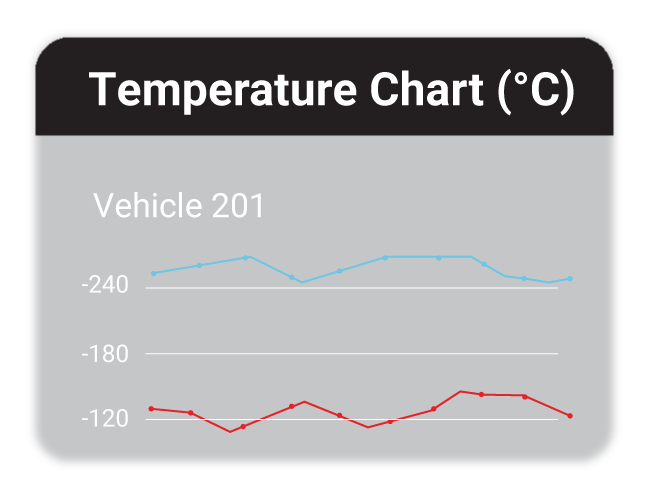
Multi-point temperature tracking


Monitor multiple sensor inputs across compartments and storage zones
Humidity monitoring
Track moisture levels to maintain product stability during transit
Centralized monitoring view
Access real-time climate data across all vehicles in one platform
Cold Chain Risk Intelligence
Identify invisible risks early
and act instantly
Move beyond threshold alerts with environmental analytics that identify early indicators of spoilage—allowing you to act before damage occurs.
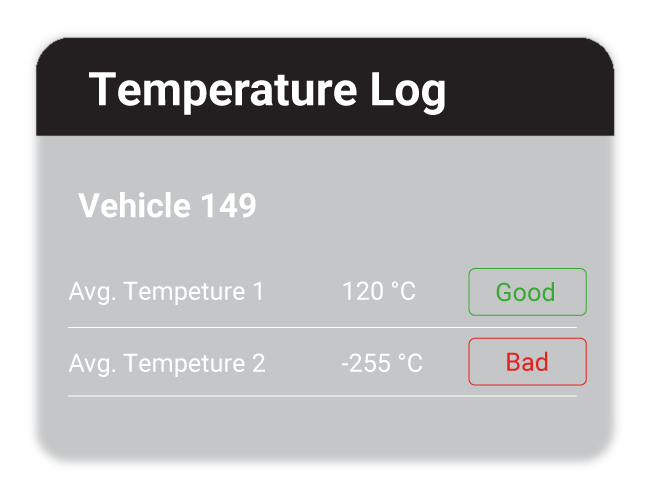
Mold Risk analysis
Identify environmental conditions that support biological growth early
VPD and dew point monitoring
Detect moisture imbalance and condensation risk
Real-time deviation alerts
Respond immediately to abnormal temperature or humidity changes
Automated data logging
Record all temperature and humidity changes without manual input
Historical condition tracking
Review past shipment performance and identify recurring risks
Audit-ready reporting
Generate structured records for compliance and client verification
Frequently asked questions
What is a cold chain monitoring system and how does it work?
A cold chain monitoring system continuously tracks temperature and humidity conditions across transport and storage environments using connected sensors and telematics software. It ensures that temperature-sensitive goods—such as food, pharmaceuticals, and chemicals—remain within required conditions throughout the entire journey.
SafeConnect enhances this by combining:
- Multi-point sensor data (temperature + humidity)
- Real-time monitoring with automated alerts
- Structured data logging for full shipment traceability
This allows you not only to monitor conditions, but to validate that every shipment meets required standards from dispatch to delivery.
How does the system prevent spoilage and cargo rejection?
The system functions as an early-warning and response mechanism. It continuously detects temperature deviations, humidity imbalance, and environmental risk indicators—allowing immediate corrective action before damage occurs.
Key capabilities include:
- Real-time alerts: Immediate notification when conditions exceed defined thresholds
- Environmental risk detection: Identify hidden risks like condensation or mold-prone conditions
- Corrective action enablement: Reroute, adjust cooling, or intervene before product loss
This proactive approach is critical because even minor temperature deviations can lead to spoilage, compliance failure, or rejected deliveries.
How does this help with compliance and audit requirements?
Cold chain operations are highly regulated, especially in food and pharmaceutical logistics. Monitoring systems play a critical role by providing verifiable records of temperature control throughout the journey.
SafeConnect supports compliance by:
- Automated temperature logging: Capture every environmental change without manual input
- Historical shipment records: Maintain traceable data for audits and investigations
- Proof of integrity: Demonstrate that goods remained within required conditions
This allows businesses to:
- Pass audits with confidence
- Reduce disputes with customers
- Provide documented proof of product handling quality
Do I still need monitoring if my trucks already have refrigeration units?
Yes—and this is where many operators misunderstand risk. Refrigeration systems control temperature, but they do not:
- Provide independent validation
- Detect unnoticed failures or fluctuations
- Generate audit-ready proof
A monitoring system adds a verification layer, ensuring:
- Temperature is actually maintained (not assumed)
- Equipment failures are detected immediately
- You have evidence to defend claims and disputes
Without monitoring, you are operating on assumption—not proof.
Can I monitor multiple compartments or different cargo requirements?
Yes. The system supports multi-sensor configurations, allowing you to monitor multiple compartments or zones within a single vehicle.
This is critical for operations handling mixed cargo, such as:
- Frozen and chilled goods in the same vehicle
- Pharmaceuticals with different temperature thresholds
You gain:
- Compartment-level visibility
- Independent condition tracking per zone
- More accurate validation across complex deliveries

Sorry, the comment form is closed at this time.